Practice & Discussion
Quick Check
Inquiry Task
Confucius's "learning" (xue) encompasses studying books, practice, and self-cultivation throughout one's life. In "to learn and in due time practice what one has learned," "practice" (xi) refers to repeated practice and personal application—learning without practice is not truly learning. So "learning" is not merely book study; it also includes practice and self-cultivation.
This understanding narrows "practice" (xi) to mere review, neglecting practice and self-cultivation. "In ancient times, scholars learned for themselves; today, scholars learn for others" shows that the purpose of learning is to enrich oneself, not to put on a show. If one only reviews test points for high scores, one falls into learning "for others."
Junzi character is formed in a sequence: the Odes inspire the mind, the Rites regulate conduct, and Music completes harmony. "When substance and refinement are in harmony, one becomes a junzi" emphasizes the balance between inner simplicity and outer refinement. Thus, the junzi is not confined to a single skill but is a person of complete virtue and broad vision.
This page discusses Confucius's view of learning and junzi character. For him, learning was not rote memorization of knowledge but lifelong self-cultivation; the junzi is the personal ideal that such cultivation aims to achieve. The two support each other: learning is for becoming a junzi, and junzi character is manifested in continuous learning.
The core questions are: What exactly does Confucius's "learning" involve, and why learn? How does it point toward the "junzi" ideal? Learning objectives include: explaining how Confucius's "learning" differs from traditional rote learning in content and purpose; explaining the relationship between learning and thinking; listing several characteristics of junzi character; and describing Confucius's methods of启发式 teaching and teaching according to aptitude.
"To learn and in due time practice what one has learned—is that not a pleasure?"The Analects, Xue Er
Here "learning" and "practice" are treated as inseparable, emphasizing repeated practice and personal application; learning without practice is not truly learning. The purpose of learning lies not in external praise. Confucius said:
"In ancient times, scholars learned for themselves; today, scholars learn for others."The Analects, Xian Wen
Learning to enrich oneself and learning to put on a show for others are two different attitudes. In terms of content, the Odes, the Rites, and Music form a sequence of character formation:
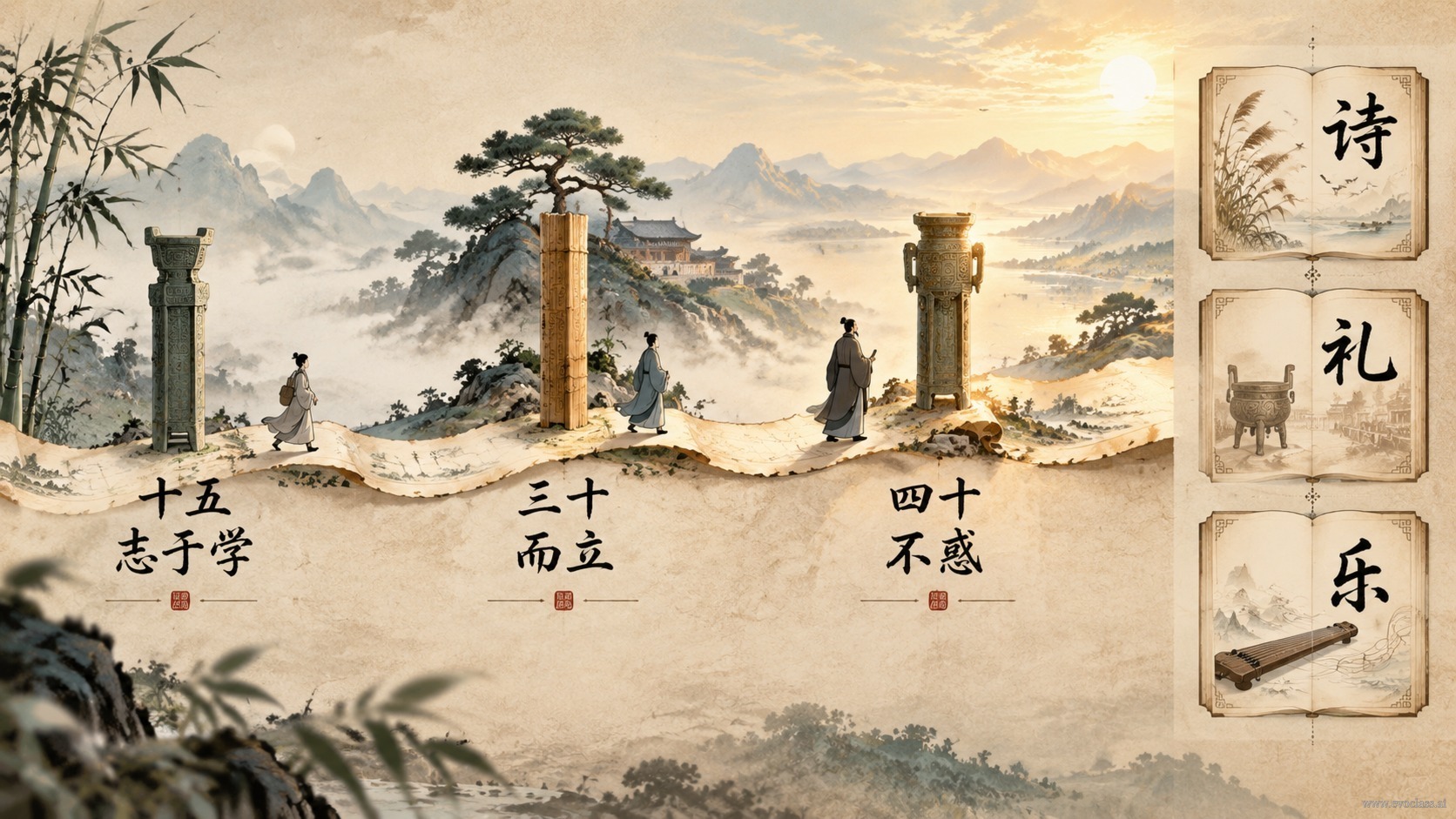
"Inspired by the Odes, established by the Rites, perfected by Music."The Analects, Tai Bo
Confucius also described himself: "At fifteen, I set my heart on learning; at thirty, I took my stand; at forty, I had no doubts" (The Analects, Wei Zheng), treating learning as a lifelong, continuously advancing process rather than a task confined to a particular period.
In The Analects, the junzi is contrasted with the "petty person" (xiaoren). The term originally also referred to people of high status, but Confucius shifted the emphasis toward virtue. The junzi is not limited to a single talent or skill, hence "the junzi is not a vessel" (Wei Zheng); he is broad-minded, hence "the junzi is calm and at ease, while the petty person is always anxious" (Shu Er); he can live in harmony with others without blindly following, hence "the junzi seeks harmony but not uniformity; the petty person seeks uniformity but not harmony" (Zi Lu); when problems arise, he first looks for the cause in himself, hence "the junzi seeks within himself; the petty person seeks from others" (Wei Ling Gong).
Confucius also mentioned "the junzi has three cautions" (Ji Shi), reminding people at different stages of life to guard against imbalances of temperament; and "the junzi has nine things to reflect on" (Ji Shi), bringing self-cultivation down to specific details such as seeing, hearing, countenance, demeanor, speech, conduct, doubts, anger, and gain. "When substance and refinement are in harmony, one becomes a junzi" (Yong Ye) emphasizes the balance between inner simplicity and outer refinement—neglecting either side disqualifies one from being a junzi.
Reflection: If you were to redesign a learning task with the attitude of "learning for oneself," how would you adjust it?
"Learning without thinking leads to confusion; thinking without learning leads to peril."The Analects, Wei Zheng
Reading without thinking leads to confusion with no direction; thinking in a vacuum without learning from others leads to doubt and unease. Together, these two lines show that learning and thinking are mutually dependent and should alternate. A corresponding method is "Reviewing the old to understand the new—such a person can be a teacher" (Wei Zheng): reviewing past knowledge is not repetition but gaining new understanding from it—only then is one qualified to teach others.
On the teaching side, Confucius advocated: "I do not enlighten one who is not struggling to understand; I do not instruct one who is not struggling to express himself. If I raise one corner and the student cannot come back with the other three, I do not repeat myself" (Shu Er): unless a student has wrestled with a question himself, Confucius does not rush to open up his thinking—the responsibility for thinking remains with the student. He also advocated "education for all without discrimination" (Wei Ling Gong)—instruction does not discriminate by social origin. There are numerous examples of teaching according to aptitude in the text—when different disciples asked about benevolence or governance, Confucius gave different answers, guiding each according to their individual temperament.